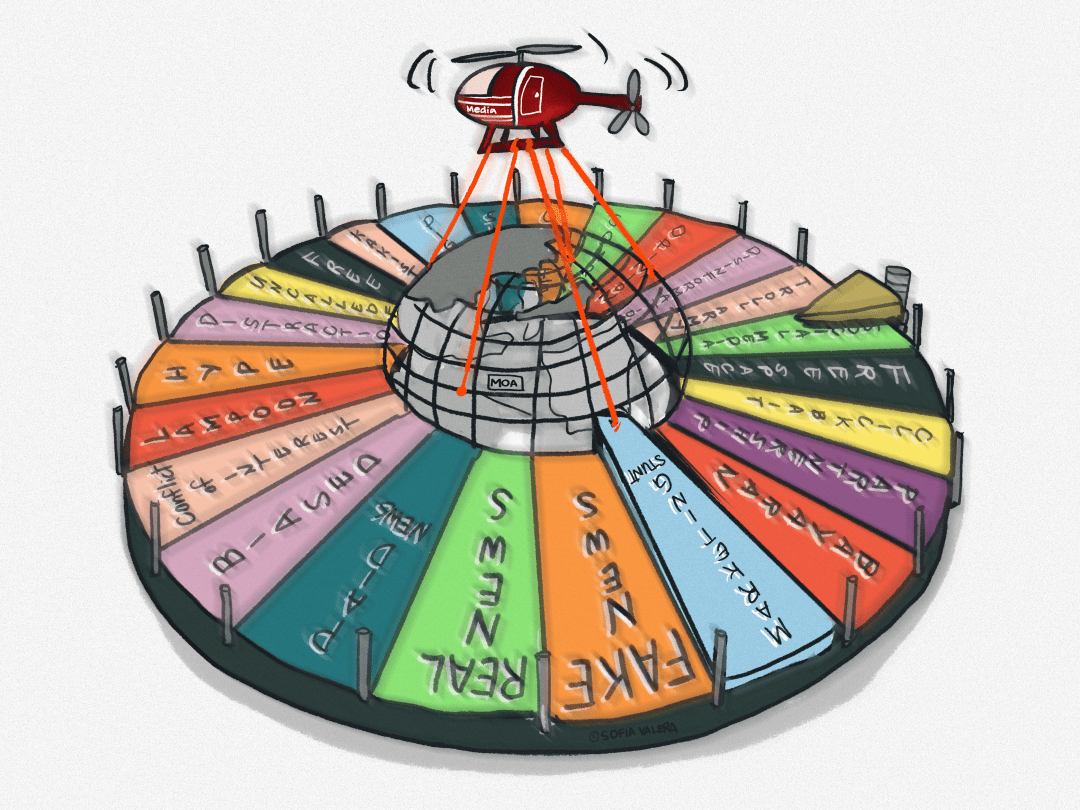
It was November 13th, at approximately 11 o’clock in the evening based on Philippine Standard Time, the prominent SM Mall of Asia Globe was reportedly stolen. News and media outlets were quick to provide coverage on the alleged heist.
Come daybreak the following day, it was revealed that the “heist” was a publicity stunt for an upcoming movie to be released on the streaming platform Netflix.
While it was not yet revealed to the public what had happened to the MOA Globe, people began to form their own conspiracy theories. One of the theories was covert military exercises “in country” done by elite helicopter pilots who participated in the Bin Laden raid in 2011. Aside from the conspiracy theories came the memes, the allegations of theft committed by IKEA mascot Tito Ball, and more pertinently, the criticism. The main argument of critics was that news and media outlets should not partake in publicity stunts for whatever reason they can provide.
One of the news media giants, Rappler, released a story purporting to be news which captured the gaze and piqued the interest of Filipino netizens. Netizens were quick to point out that such a stunt was done in poor taste due to the blatant spread of fake news in social media platforms utilized by Filipino netizens.
We agree. It is insulting to say, at the very least, that a news media giant such as Rappler would participate in such gimmickry. It smears its own reputation of being a legitimate source of actual and factual news just to profit off the marketing of Netflix’s Red Notice.
We could end it here and move on. People who dismissed and criticized the publicity stunt have expressed their opinions and moved on. People eventually let this matter rest but for us, we feel that we have to reaffirm our commitment towards providing news with accuracy and integrity. We owe the public high standards of accountability, sense of urgency, and credibility so that falsity will not poison the citizenry.
The heist, which in reality was a publicity stunt, revealed the grim reality of how easy it is for the media to maneuver and control the public. Indeed, it acts not only as a catalyst of information but also it proves to be a great navigator that sets the compass of public opinion. As harmless as the promotion of a new film or series may be, the fact that many were quick to believe that something more sinister was afoot shows just how readily people are willing to believe what the media shows them.
Hook, line, and sinker.
“Our job is to report the news, not to manufacture it,” said Gus Haynes in HBO’s The Wire, Season 5, Episode 10. In the show, the character Augustus “Gus” Haynes is an editor for The Baltimore Sun. He spat out those words in a row between him and the managing editor over a defective, and fabricated news article. It is indeed true, accurate, and applicable to what happened on the night of November 13th.
It is a dangerous thing when news and media outlets partake in a publicity stunt. It is not limited to a question of credibility but more of integrity. The purpose of journalism is to provide the public with accurate information on current events. How should the people trust journalists when the news reporting becomes a peddling activity, a make-believe for some reason?
The power of the media is not unheard of. Often referred to as the Fourth Estate, the general concept of media has played a decisive role in the history of molding empires. The First and Second World Wars were dictated by the efficiency of state-controlled media in altering a nation’s collective memory, and by promoting groupthink through propaganda—as was in the case of Hitler-ruled Germany. The British government fought fire with fire when it proliferated motivational posters containing the now meme-famous and heavily parodied “Keep Calm and Carry On” quote, which raised public morale and galvanized the British in actual combat and in the home front. Indeed, mere words have shaped the world that we live in today. As our National Hero Dr. Rizal has succinctly and profoundly put it, “the pen is mightier than the sword.”
In our local context, another war is brewing: the war on disinformation. With the advent of the Internet, information—whether true or otherwise—propagates on social media platforms in exponential fashion. Newspapers of general circulation and news media outlets now take advantage of such platforms in order to notify the public of the current events and ongoing concerns of our country. However, others utilize this technology with malicious intent to muddle facts and manipulate public opinion.
Clearly, the stunt had repercussions that Rappler and other news outlets were not able to foresee. It eroded the confidence of the netizens in the content that they released. Now, it is as if one needs to be on perpetual guard and constantly check the veracity of the news even if such was shown through legitimate media outlets.
Without a doubt, this incident has set a precedent and now the netizens will think twice before believing the content they consume. Concomitantly, the trust of readers long earned throughout years of service has been put to the test.
As innocent as the stunt may be, it comes at an inopportune time when fact-checking posts online has unfortunately become an exception rather than the norm. With Facebook and Tiktok universities leading the charge in the spread of propaganda and misinformation, it is quite unnerving that reputable media entities are themselves showing how easy it is to fabricate stories just for the sake of publicity. One cannot help but wonder if such tactics can, and are, also being employed with regard to legitimate issues of public concern, but judging by the rampant whitewashing and revisionism of key political issues, the answer seems rather obvious. Regardless of where you stand on the issue, the ease with which the public is so easily manipulated does not bode well for a country gearing up for a national election where propaganda seems to be the name of the game.
With such an event, one vital question begs to be asked—how can we continue to fight for the preservation of our democratic institutions in this populist strongman-dominated government when one of the primary societal actors expected to resist tyranny like the media, takes advantage of their power to sway and influence public opinion?
 THE BARRISTER