Digest by John Alfred Rabena
Graphics by Jed Paul O. Naval
FACTS: Francisco Chavez initiated the prosecution of the Marcoses and their cronies who committed unmitigated plunder of the public treasury and the systematic subjugation of the country’s economy. Chavez was impelled to bring this action because of several news reports bannered in a number of broadsheets sometime in September 1997 that referred to (1) the alleged discovery of billions of dollars of Marcos assets deposited in various coded accounts in Swiss banks; and (2) the reported execution of a compromise, between the government (through PCGG) and the Marcos heirs, on how to split or share these assets.
Chavez invoked his constitutional right to information and the correlative duty of the state to disclose publicly all its transactions involving the national interest. He demanded that respondents make public any and all negotiations and agreements pertaining to PCGG’s task of recovering the Marcoses’ ill-gotten wealth.
ISSUE: May the Supreme Court require the PCGG to disclose to the public the details of any agreement, perfected or not, with the Marcoses?
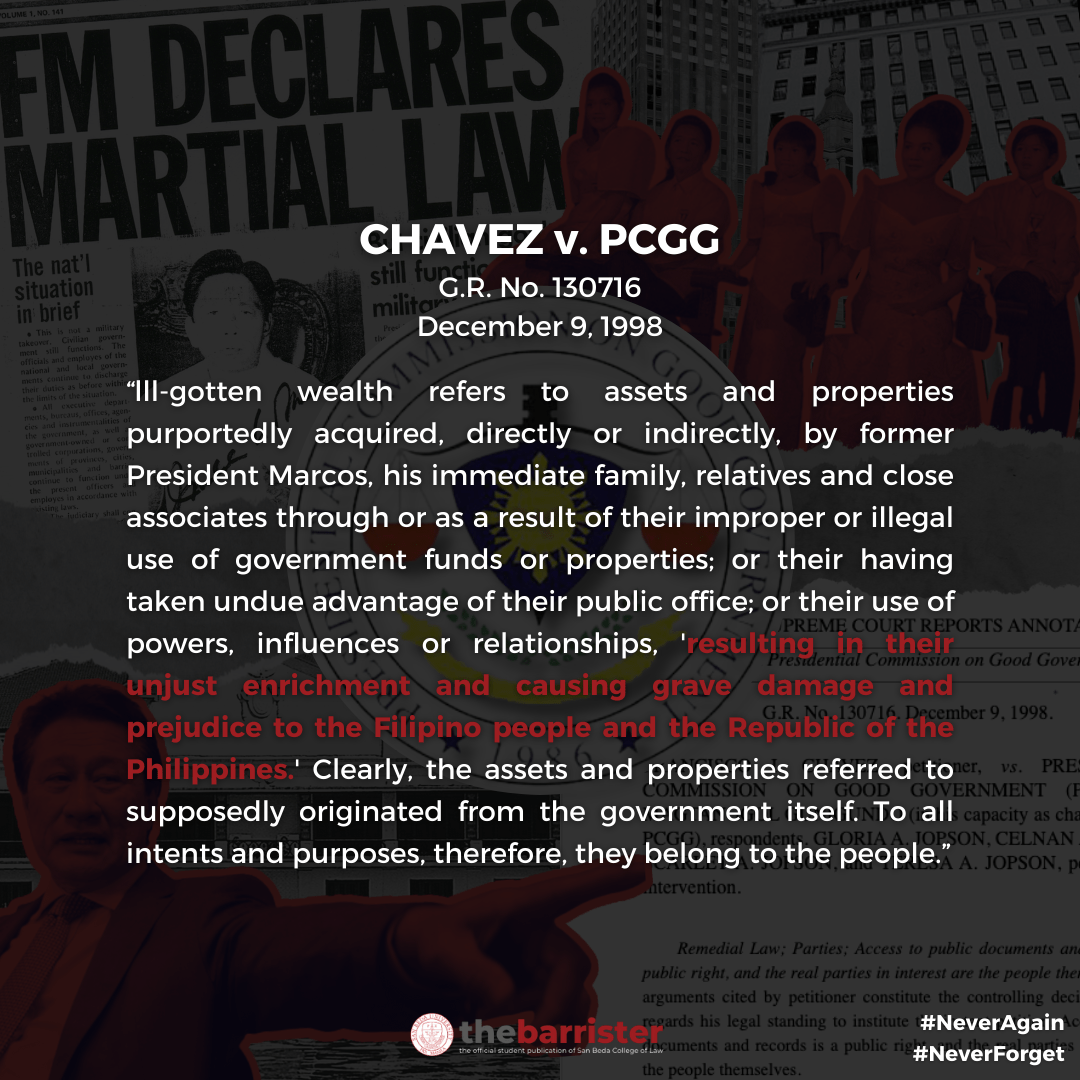
RULING: Yes. With such pronouncements by our government, whose authority emanates from the people, there is no doubt that the recovery of the Marcoses’ alleged ill-gotten wealth is a matter of public concern and imbued with public interest. It may also be added that ill-gotten wealth,” by its very nature, assumes a public character. “ill-gotten wealth” refers to assets and properties purportedly acquired, directly or indirectly, by former President Marcos, his immediate family, relatives and close associates through or as a result of their improper or illegal use of government funds or properties; or their having taken undue advantage of their public office; or their use of powers, influences or relationships, “resulting in their unjust enrichment and causing grave damage and prejudice to the Filipino people and the Republic of the Philippines.” Clearly, the assets and properties referred to supposedly originated from the government itself. To all intents and purposes, therefore, they belong to the people.
Hence, it is incumbent upon the PCGG and its officers, as well as other government representatives, to disclose sufficient public information on any proposed settlement they have decided to take up with the ostensible owners and holders of ill-gotten wealth. Such information, though, must pertain to definite propositions of the government, not necessarily to intra-agency or inter-agency recommendations or communications during the stage when common assertions are still in the process of being formulated or are in the “exploratory” stage.
 THE BARRISTER