By: Ramon T. Bautista, John Michael Opendo, and Jayzamel Vista
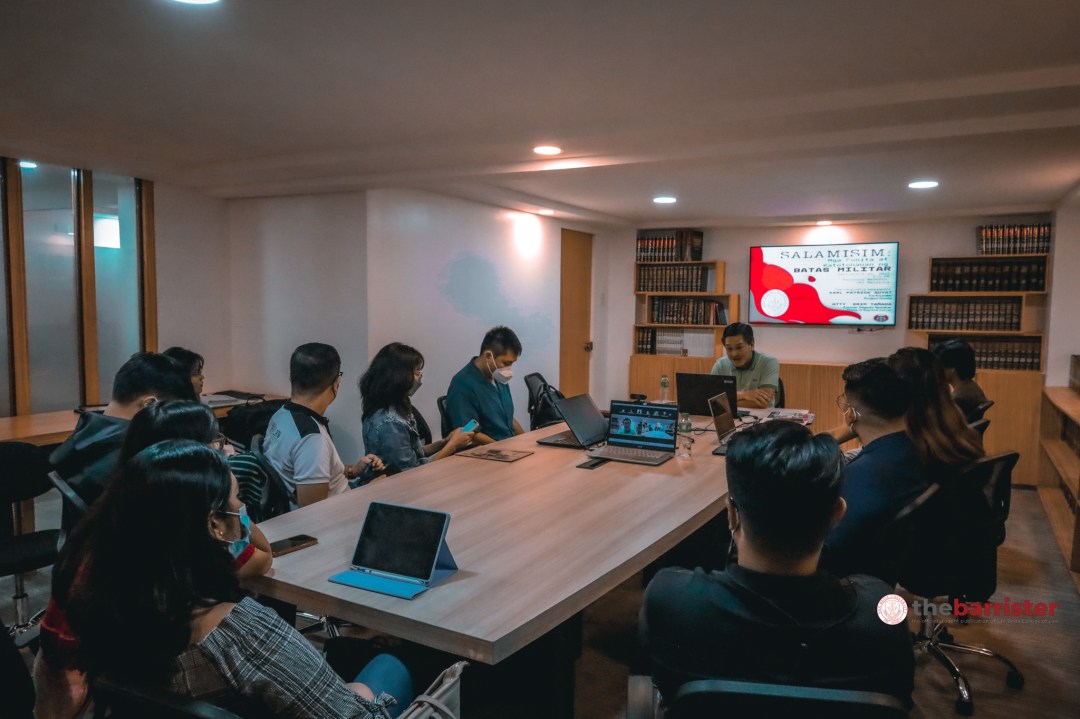
In commemoration of the 50th anniversary of the declaration of martial law, the San Beda Law – Human Rights Advocates (HRA) conducted its first face-to-face seminar since the pandemic, titled “SALAMISIM: Mga Gunita at Katotohanan ng Batas Militar” last September 24.
The event was a recollection of the atrocities of the Marcos Sr.’s regime and discussion of avenues against historical revisionism. It was held at the San Beda College of Law Dean’s Office Conference Room while simultaneously being live streamed via Zoom.
The first speaker was Atty. Erin Tañada, former House of Representative Deputy Speaker and a well-known advocate for human rights and labor rights. He stressed the vital role law students play in the battle for human rights. “Importante para sa ating lahat na we put into context what has happened before.”
The last speaker was Karl Patrick Suyat, co-founder of Project Gunita which is a network of volunteers committed to the defense of historical truth. Suyat comes from a family of activists. His grandfather was a political detainee during the last years of Marcos and received threats on his life.
Cannot “Move On”
Atty. Tañada made a bold statement to counterattack the call to the Filipino public to “move on” from this issue. In a press conference, two incumbent senators have rejected the idea of the Marcoses from apologizing for the abuses committed during the martial law.
“Sinabi ni[la] Senator Jinggoy [Estrada] at Senator Robinhood [Padilla], ‘mag move on na.’ Hindi pwedeng mag-move on eh. Unang-una, wala naman acknowledgement galing kay Pangulong Bongbong Marcos sa mga nangyari noong martial law. Paano makaka-move on lalong-lalo na ‘yung mga biktima ng martial law?” Atty. Tañada said.
“Paano makaka-move on, unang-una hindi naman good citizen ang ating pangulo dahil hindi naman nagbabayad ng buwis–estate tax and income tax. Sana act of goodwill noong umupo siya, ‘Babayaran ko na ‘yung utang ko.’ At least, brownie points para sa kaniya. Pero hanggang ngayon, hindi.” he added.
Atty. Tañada also highlighted the matter regarding the ill-gotten wealth of the Marcoses and that such an issue must no longer be disputed. “[T]he Swiss government returned to the Philippine government an amount from their [Marcoses’] Swiss banks [accounts] with the condition that they would only transfer the amount if the martial law victims are compensated. There is proof that there is ill-gotten wealth,” he said.
Human Rights Violation Denial
Atty. Tañada also addressed those people who are still denying the human rights violations and abuses during martial law despite the overwhelming data gathered by several studies.
“Bagama’t sinasabi ng datos na 11,107 ang binigyan ng compensation, para sa akin mas mahigit pa ang human rights violation sa ating bansa. Based on the data, 75,000 mahigit ang nag-file. Hindi lang na-approved sila dahil kulang sila sa dokumento. 11,107 is a depressed number. I am sure it is more than that. There is data and based on fact,” he said.
Furthermore, he expressed his call for Filipinos to be vigilant. “Kaya malaki pa rin ang papel natin dito sa ating bansa… [O]ur journey in this project of democracy is still unfinished. We have to make our country much more equitable than what we have right now,” he stressed.
Archives to Fight Against Disinformation
Suyat disclosed how hard it was to accept that the son of Mr. Marcos would win in the 2022 Presidential election despite the well-documented evidence of the abuses and the plunder that the Marcos dictatorship did during its 20-year rule from 1965 to 1986. “Mas mahirap tanggapin ang advent of disinformation na sumabay sa rise of social media here in the Philippines.”
He emphasized the need to protect the archives due to their significance as documentary confirmations of the horrors of martial law in the fight for justice and truth. One of the goals of Project Gunita is to “complete the story for the ordinary people.”
“Martial law was not just a story between two families. It wasn’t just Aquinos versus the Marcoses… We wanted to focus on the legal system during the Marcos dictatorship, how Marcos mangled the law,” he added.
Suyat also firmly believed that the Marcos family has an “emotional baggage” why they will go after the archives. “It is not a matter of if, but is a matter of when… Ang unang tinitira ng mga diktador or fascist leaders or regime ay ‘yung archives. Tatlo yan: the archives, the libraries, and the museums,” Suyat stressed.
Moreover, he reminded people the importance of archives. “It gives us a glimpse of what has happened before through the pages from the past or the pages of history,” he said. “Mahirap nang mag-ipon ng archives at mag-scan ng archives if the threat is already there and is about to happen,” he added.
 THE BARRISTER