By Milliene Ianah Rocas
San Beda University (SBU) hosted the recently conducted 4th annual Philippine Law Debate Championship (PLDC4) last September 28-30, 2023. The three-day PLDC was organized by the San Beda Law Debate Circle, the official debating team of the SBU College of Law headed by its President, Jay Emmanuel Lagamia together with Deputy (Tournament Director) Director Maltha Denise Villarubia.
PLDC4 catered 16 distinguished law schools across the country, namely: University of Mindanao, Liceo de Cagayan University, Saint Louis University (SLU), and Ateneo de Davao University. Schools and universities nearby, and in Central Manila also had its representatives from the Polytechnic University of the Philippines, University of Caloocan City, University of Santo Tomas, San Sebastian College Recoletos de Manila, Arellano University School of Law (AUSL), San Beda College Alabang School of Law (SBCA School of Law), our very own San Beda University College of Law, and this year’s PLDC4 Champions – University of the Philippines College of Law (UP Law).
The Bullpen and Run for the Best
Five rounds of rebuttals and counter-rebuttals narrowed the debating teams to eight. Teams DeepthROAR (UP Law), Alab 2 (SBCA School of Law), Team Status Quo (AUSL), Frank and the Ube Jam Factory (SLU), Forensic, ROOOOAAAAAAARRRRRRRRR, Team Titans, and Team Higalaay advanced to the final leg of the PLDC4, forwarding through five powerful rounds of debate.
Four triumphed over the quarter finals motion about “family.” Fierce, agitation, and intensity filled the several debate rooms at the Lion’s Den, living up to this year’s hashtag #Roar4All as these eight teams heatedly argue for their side of the house, and conquers a spot in the semi-finals with these quarter finals motions:
“This house would decriminalize marital infidelity.”
“This house would allow a testator to disinherit compulsory heirs for any ground.”
“This house believes that impugning legitimacy should be imprescriptible.”
These four teams are the UP Law, SLU, AUSL, and SBCA School of Law. They argued about “women,” making arguments and hypotheses with these topics:
“This house believes that courts should consider the systematic oppression faced by women as a mitigating factor in criminal sentences for violent crimes committed against their abusers, even if they have not been diagnosed with Battered Woman Syndrome.”
“This house regrets the emphasis on the law on rape on biology (ie emphasizing in some cases that the penis should be erect, that it should touch or penetrate certain parts of the vulva, etc).”
“This house would decriminalize abortion.”
Last Team Standing
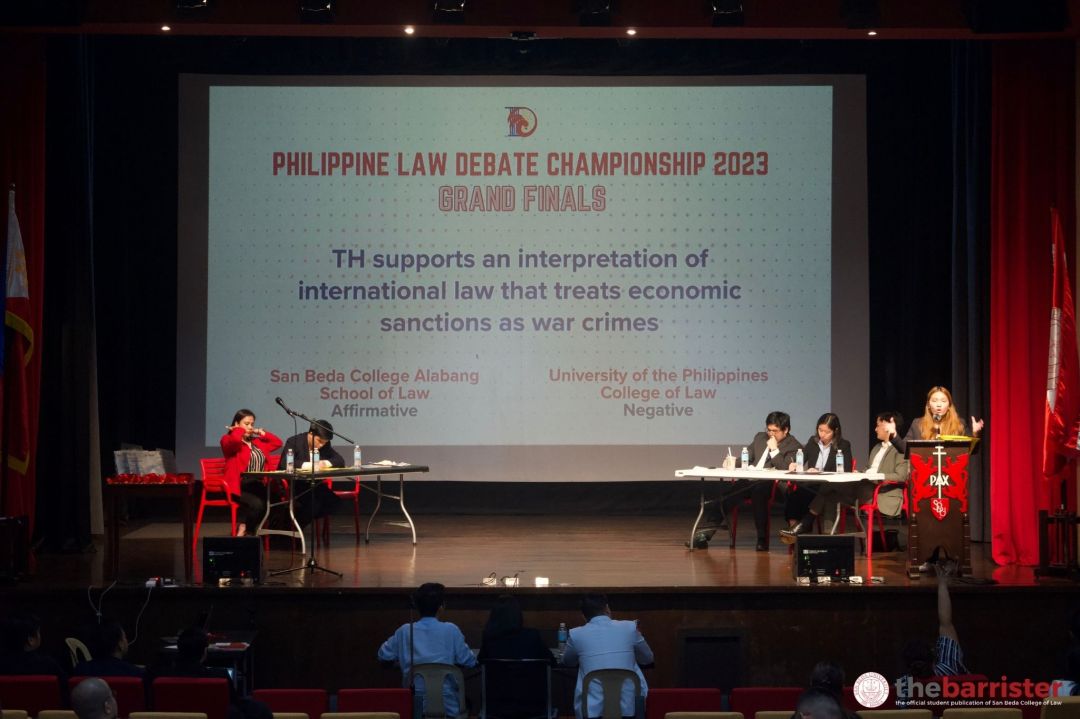
Securing their spots in the grand finals, UP Law and SBCA School of Law rests onto the peak of the event. They dueled with the topic:
“This house supports an interpretation of international law that treats economic sanctions as war crimes.”
SBCA Necessity speaker opened the motion for the affirming side, pointing out that economic sanctions amounting to the deprivation of basic needs for survival to demand compliance of a policy from another country, is ineffective.
“What happened in Iraq for instance was that they totally absolved or removed all the financial trades and economic possibilities that Iraq will have just because United States want their government to comply.”
“Coming from an international law perspective, it’s important that we already understand limiting people’s resources to no choice amounts to an environmental crime. We also analyze that these economic sanctions are ineffective.”
SBCA further argued that the government has the tendency to impose economic sanctions with least negative consequences to its people by weighing humanitarian costs and is therefore being accountable,“by treating economic sanctions as potential war crimes, we bring accountability into the equation, ensuring that the nations weigh the humanitarian cost before imposing these sanctions. Innocent civilians, especially in conflict zones, often pay the highest price when economic sanctions are imposed.The sanctions can lead to medical shortages, malnutrition, and even a dire lack of opportunities that deepened the cycle of poverty.”
SBCA Law argues that economic sanctions, if not to be treated as war crimes, will continue to be used as a tool by powerful states like America to deprive other countries of basic needs:
“Economic sanctions are unlikely ever to be stopped. We see this when, for example, a superpower like the US essentially stifles another nation-state’s access to essentials like food, water, medicine. Essentially, it’s an application of soft power that deprives another nation state of its bare essentials and its livelihoods essentially acting as an extension of attacking civilians to the point of death.”
UP Law made the counter-rebuttal that economic sanctions is the last and least evil of all alternatives available to sanction erring states.
“The last remaining tools in the toolbox in order to deter and in order to punish erring states that do not involve the use of violence, that does not involve the use of armed force. But the question is, if not economic sanctions, what other tool can be used in order to solve erring states that disregard human rights, disregard the rules of international law.”
The speaker continues that an essential element of war crimes is the presence of international armed conflict, which is not present in economic sanctions, negating the motion that treats economic sanctions as war crimes.
“An essential element of war crimes in the Geneva Rome Statute is the presence of international armed conflict.The EU imposed sanctions on Russia and North Korea, and they’re currently not at war.”And that the United Nations itself recognizes economic sanctions as a valid tool to punish erring states.They have done it to Libya, they have done it to Russia, they have done it to a lot of states that have committed violations of international or violations of crimes against humanity.”
UP Law maintains their proposition that economic sanctions are the least evil of all and still the most effective even if it incidentally harms people. With the conclusion that:
“Because you are able to stop the very threat to dictators post it is not simply your lack of access to goods that harm these people, it’s the fact that people are able to stay in power that take away your human rights.We also have to recognize that countries have no obligation to provide you with aid. Why is it now a war crime to decide that you don’t deserve my money because you aren’t giving people democratic rights?We can impose pressure without requiring states to feel the need to use violence and force and therefore increase peace.”
The University of the Philippines College of Law team DeepthROAR won with the score of 5-0.
 THE BARRISTER