By Carlota N. Villaroman and Anna Carmela C. Dela Cruz
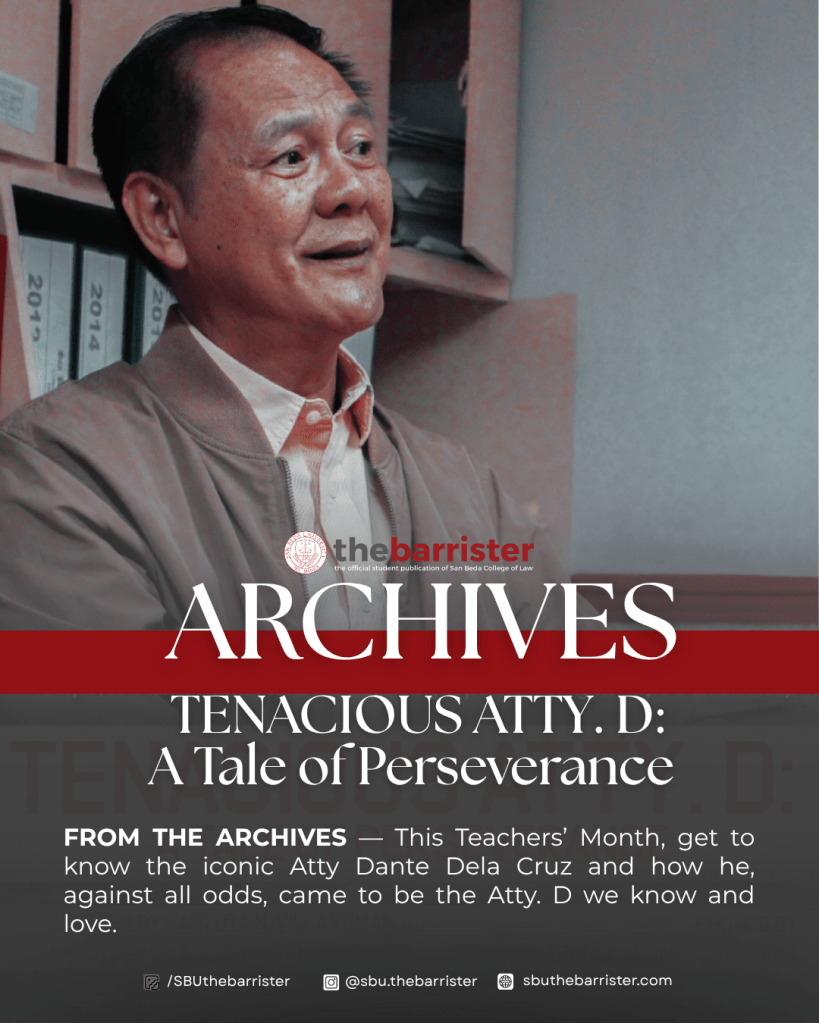
Photo by Marina Antoinette H. Cruz
“Let the people tell you who you are. “
These were the first words the interviewee said in defining himself. He was answering in a perplexed state, not because he is unable to define himself as a person, but because he is a man built by different personal circumstances— some not by choice, but all led to where he is now.
Atty. Dela Cruz, or “Atty. D” as he is fondly called by his students, was born in Caloocan City. He spent his childhood in Guinobatan, Albay where he grew up only with his mother and grandmother. He also lived in the squatters’ area in Bagong Barrio in Manila. He never met his father as a kid, having only known him by the time he was a full-fledged lawyer.
The early parts of his life were spent in helping the family make ends meet. He used to sell pandesal every morning before going to school. He also used to sell plastic every afternoon and collect junk with a friend using a kariton along Monumento Market, going to Espiritu Drive (now Cloverleaf) in Monumento. Enchantingly, he recalled that his early exposure to selling different products, including sinampot or maruya, brought harness to his arithmetic.
Despite the hardships, he was determined to finish his education. This drive was spurred by the fact that his guardians barely finished grade school: his mother reaching Grade 2, and his grandmother Grade 4. From the start, he knew he had a responsibility to his family; in finishing his education, he was to help alleviate their financial woes. He was supposed to bring pride to them by earning himself a degree, a reflection of all their hard work and patience.
Initially, Atty. D never planned to be an accountant, much less a lawyer, “Yung financial condition namin, you will never even dream of finishing a college course,” he said during an interview with thebarrister.
When asked why he chose Accounting as his major (his undergraduate degree was Commerce), he laughingly told us that when he was in his third year in college, he just put “Accounting” because he met someone who had also put the same. He chose his major based on what he thought was the easiest.
“Na-encourage lang ako mag Law kasi parang maganda siyang profession,” he said. “Kaya magandang continuation ng Accountancy, nagpursige ako. Kasi sabi rin ng lola ko, magandang maging lawyer ako.” Predominantly, he wanted to make her mother and grandmother happy when he pursued Law.
What he really wanted to be was a basketball or volleyball player. As a student, he survived on scholarship grants as an athlete. He dreamed of becoming a professional player someday, but felt like it was not his fate, “Nakita ko, hindi ako aasenso sa basketball. Why not concentrate on my studies? So nag concentrate na ako, eh yung para bang eye-opener ni God. While I want you to have what you want, you are not meant for that,” he said.
He only took one entrance examination. He set his eyes on San Beda College because of its good reputation as a law school. By then, it was San Beda or nothing—if he did not pass, then the profession was not for him. By God’s grace, he passed and got accepted.
Atty. Dela Cruz belonged to the working class section and attended classes from Monday to Saturday every week while working in a law firm. During his years as a law student, he faced struggles he believed were not entirely different from what the students of the College of Law are facing at present. He faced constant pressure of not being able to fully prepare for a recitation. There were instances when he knew he was well read on the topic but was surprised by a question that seemed out of the ordinary. He also had moments when he would be nervous about being called by a professor to recite.
“Don’t leave it to chances, always prepare. There is no substitute for preparation.”
In retrospect, he said he was lucky. There were times when the professor would ask a question he did not know the answer to, but he was not the one called to recite. One particular question he could not forget was in Civil Procedure where the question was ‘Summons, singular or plural? Imagine kung sa akin natanong? Eh, ‘di ko rin alam!” He exclaimed. “Thank God, hindi sa akin natanong.”
However, despite acknowledging the presence of luck in his journey as a law student, he still maintained that preparation is always the key. This is one thing he always tells his students when they ask him for advice: always be prepared. “Don’t leave it to chances, always prepare. There is no substitute for preparation.”
He equates the effectiveness of studying in this fashion: “Depende ‘yan kung mababaw ang itinanim mo o malalim.” He emphasizes the importance of concentration and focus on everything one intends to do or achieve.
Interestingly, his dreams of becoming a professional basketball player were not altogether forsaken when he entered law school. For years, he remained a member of the basketball team of San Beda College of Law and has participated in Conflicts of Law, an annual competition on sports and others among the different law schools around the region. In fact, the friendship he established with his basketball peers did not ignite his interest to further join fraternities. For him, the camaraderie he had with them was more than enough bond and brotherhood.
Atty. Dela Cruz also admitted that much of the teaching style he has now is deeply influenced by the prominent professors he had back then. He extended much appreciation to Dean Virgilio B. Jara who brought so much vigor in the class, and to Justice Isagani A. Cruz, whom he noted to be a poetic Constitutional Law professor. He also recalled the times he enjoyed certain law subjects such as Legal Accounting where accounting principles and legal principles are intertwined.
Throughout law school, his non-negotiable stand on “Ora et Labora” never faltered. In 1990, he was admitted to the Philippine Bar. Initially, he remarked handling tax cases and election cases which were noted by him to be lucrative cases during those times. In his stay in a law firm, he recalled being invited by a friend to teach and so, the journey to teaching kindled.
Atty. Dela Cruz has been expressly vocal with his love and passion for teaching which he has been doing for more than 30 years. Since the 1980s, he has overwhelmingly enjoyed the noble profession of teaching until now that he is still doing so in his Alma Mater as well as in the Certified Public Accountant Review School of the Philippines (CPAR). He remarked the joy he gained from teaching to be “the unquantifiables or intangibles.” He accorded so much delight in guiding his students and the CPA reviewees in the path of reaching their dreams and visions in life. He stressed that his achievement will be of his students, of what they have become after being under him.
In conclusion, the accountant lawyer avowed to his strong belief that indeed, he is a teacher.
Atty. Dela Cruz profoundly declared that adversity is a test of a strong man and that humility must be the inspiring character of a person. He reminded us of listening to the signs of God and always giving our best in everything we do. When asked how he perceives and defines a true Bedan lawyer, he left a question stating “At the end of the day, did you do what you should have done?”
Truly, it is no wonder that his out of the box perspective has made him become one of the most unconventional lawyers and professors one will ever encounter.
He was right: let the people tell you who he is.
Excerpt from thebarrister’s 2019 First Issue
 THE BARRISTER