Words by: Grace Cielo F. Roque, Lovely Jane B. Pangandaman, Ma. Angela H. De Castro, and Jay Emmanuel A. Lagamia
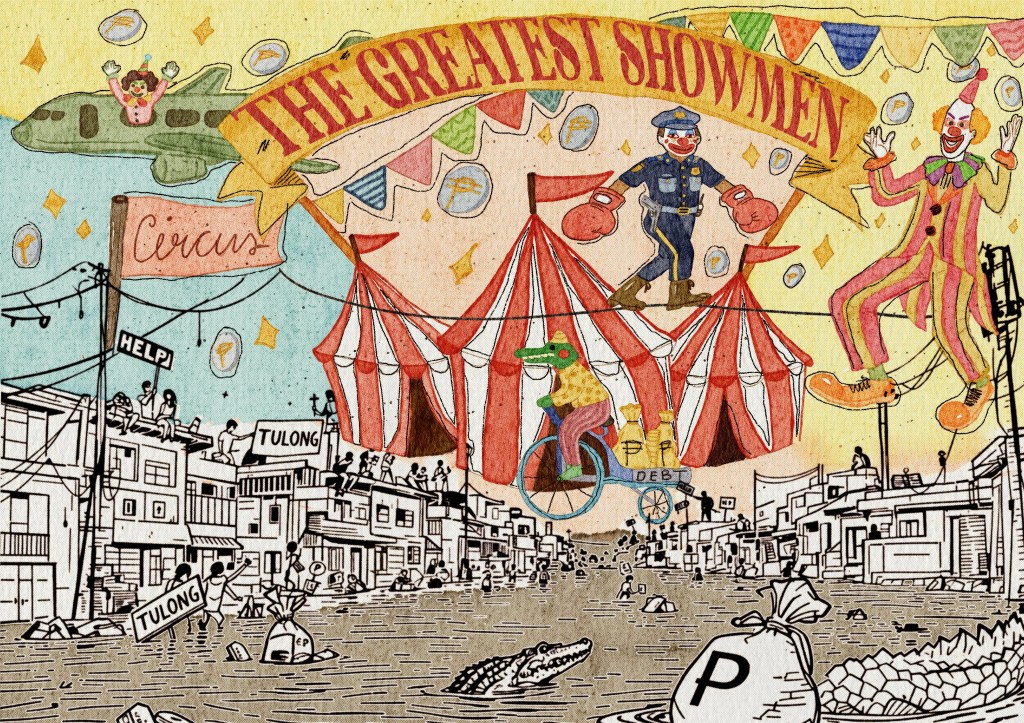
Illustration by Clarence Ayessa Pacalibre and Shyrah Amor Dela Cruz|
Under the glare of public attention, the landscape of Philippine politics has grown increasingly undiplomatic as conflict turns the image of public office into a circus of sorts.
The highly publicized standoff between Davao City Mayor Sebastian “Baste” Duterte and former Philippine National Police Chief General Nicolas Torre III in July 2025 was nothing short of diminishing the dignity of their respective offices, as the two attempted to take their petty duel of words to the ring.
As citizens watched this fruitless spat unfold across their screens, attention drifted away from more pressing concerns, where eyes on good governance should have been.
On July 20, a storm-affected Philippines heard an unusual news: acting Davao City Mayor issued a fistfight challenge to Torre, as announced on Duterte’s podcast “Basta Dabawenyo.” Three days later, Torre agreed, but proposed turning the match into a charity boxing event for the victims of the typhoon and flood.
It must be remembered that months prior, then-CIDG Chief Torre served the warrant of arrest to former president Rodrigo Duterte, the acting mayor’s father. The former president is currently detained in The Hague, under the custody of the International Criminal Court.
The boxing match scheduled on July 27 caused a media and internet frenzy. News outlets called the event “bizarre” and “farcical”, though the amount of coverage added to the sensationalism. Internet memes sprawled, making it a comedic relief.
In the end, Torre won by default after a no-show from Baste.
It was a bizarre week for Filipinos, but certainly not a new brand of political theatrics.
From neck braces to wheelchairs, Filipinos are not new to our politicians’ gimmicks. However, this may be the first time a politician issued a fist fight challenge – out in the open for everyone to hear and witness – and accepted by an equally controversial public figure.
Instead of dignified public service done within the four walls of their offices, we were serviced through a boxing match. Many paid to watch for entertainment, like watching clowns and acrobats in a circus show. But it’s been too many decades of this—have we not grown tired yet?
At some point, we have to leave the show and acknowledge it for what it is: a farce.
This deliberate avoidance of accountability through staged feuding makes a mockery of the constitutional principle found in Article XI, Section 1 of the 1987 Constitution, which declares that public office is a public trust.
To hold public office is to accept stewardship over the people’s welfare, not to exploit visibility for vindication. Officials are expected to uphold integrity, exercise restraint, and honor the duties entrusted to them.
The “Baste-Torre showdown” demonstrates how the privilege of publicity can be used to sow discord over matters of little consequence amid far graver national issues. Such spectacles serve as diversions, keeping the public from probing into rampant corruption.
The people are hungry for answers, and for those responsible to answer for their wrongdoings. Had this squabble not been elevated to headline status, the public might have turned its focus to more pressing matters. Foremost among them, the gross misuse of flood control budgets which is ironically the advocacy of the charitable fight.
As a result of the noise and attention received by the dispute between Baste and Torre, the Philippine public’s attention was led astray from relevant issues at the time, specifically those concerning the victims of successive typhoons Crising, Dante, and Emong, which caused flooding, injuries, fatalities, property damage, and landslides.
While an even bigger flood control issue later garnered much attention and was able to reach the masses quite well, the fact still stands that the “Baste vs. Torre” headline was able to steal attention from this much heavier matter.
The occurrence of the dispute between the two parties ended up wasting public attention at the end of such a series of events. Baste ended up being a no-show, and the public was effectively distracted from other issues, which needed more recognition and concern.
The people, as the sovereign, must act as the ultimate watchdogs of public servants. Only then can the government be held to the highest standards to give life to the constitutional mandate in Article XI.
The only safeguard to this endless conundrum is the people’s active participation in the pursuit of accountability. Governance is never meant to be a show. It is a privilege to lead and to serve, not to entertain or mock the governed.
From The Trial (Volume LI, First Issue)
 THE BARRISTER