By Grace Roque, Lovely Jane Pangandaman, Ma. Angela H. De Castro
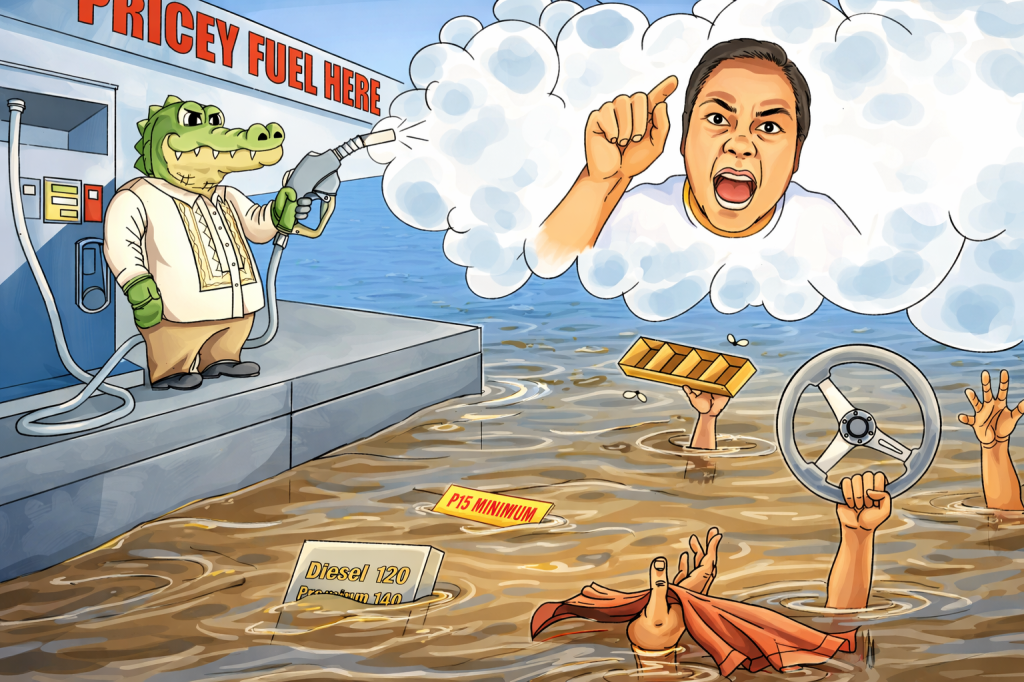
When the Strait of Hormuz closed in early March 2026, the immediate problem for the Philippines was: How long will we last with our oil reserves?
When the Strait of Hormuz closed in early March 2026, the immediate problem for the Philippines was: How long will we last with our oil reserves?
With a transport system that heavily relies on the immediate availability of diesel and gasoline in petrol stations, the more severe effects of the Hormuz crisis were looming. Data showed the Philippines could empty its oil reserves in only 60 days, much less compared to our Asian counterparts like Japan and South Korea.
It did not take long for the effects to materialize. In fact, a week into the crisis, the Department of Energy issued an anti-hoarding and fuel dispensing guideline to regulate the speed at which we were depleting our oil stock. By the 24th of March, the Philippines was already in a National Energy Emergency. In mid-April, gasoline prices peaked at Php 108 while diesel soared to Php 160 per liter, more than double their prices a month before.
With such severe effects, particularly on jeepney drivers who form the backbone of our transport sector and bear the brunt of the oil price hikes, a nagging question rings: Why is the Philippines so severely affected when other Asian countries are also dealing with the oil crisis?
This boils down to two factors: an ineffective and underinvested transport system and a lack of strategic foresight in government policy-making.
Before 2026, jeepney drivers were already confronted by uncertainty over their livelihoods due to the jeepney phaseout. Now faced with the rise of fuel prices, jeepney drivers have a significant drop in their daily earnings from Php 500-Php 700 to only Php 200-P300. To make a living, many drivers extend their shifts from five in the morning until midnight, while some opt to end their driving careers altogether.
A domino effect is now before us. Because of fewer public utility vehicles operating due to record-high diesel, the commuters are burdened with longer wait times and overcrowding in train and terminal stations. Scarcity of transport has even led to increased tardiness for students and employees. Longer commute hours contribute to increased fatigue and exhaustion, leaving many people struggling and barely making ends meet. Not to mention the financial strain placed by fare hikes that also took effect for buses, taxis, and ride-hailing services.
To make matters worse, inflation in the country skyrocketed to a three-year high of 7.2% in April, primarily driven by the inflation in diesel and gasoline rates. This led to supply-driven shocks, most present in rising food and utility costs, as well as in essential goods.
Obviously, the Filipino people are bearing the brunt of the blow with almost nothing cushioning the fall.
In response to the impact of the oil price hike, the government offered various forms of assistance and temporary fixes to ease its effects on the citizens. Subsidies were distributed to agricultural workers and public utility drivers, while lower train fares or free shuttles were given as transportation options by Local Government Units.
To alleviate the economic burden, President Ferdinand Marcos Jr. also signed Republic Act No. 12316, which allows for the reduction or suspension of excise tax for some petroleum products.
Are these measures enough for the affected sectors to get by?
The answer lies within the actions taken by the masses. Protest after protest organized by different groups, students, workers, and non-government organizations – all seeking for the government to do more. Mere band-aid solutions such as subsidies or “ayuda” can only do so much for workers trying to sustain their families, or even those simply trying to survive on their own. These temporary fixes may not be able to sustain the community’s needs in the long run.
The Hormuz crisis simply unearthed one of the Philippines’ long-buried caskets: Our government is reactive, not proactive, to crises.
Our poor public transport system is a decades-old problem that was never quite resolved by any administration. Transport policies are short-term. No law has been passed that envisions a positive, radical change to our transport system in the next 20 years.
There is overwhelming data that our transport system cannot withstand significant nudges from fuel crises. Yet, our public officials fail to utilize this data to bring about real, long-term solutions. Now, we are looking at more years of commuters piling up in clusters at the sides of EDSA, hands raised in desperate attempts to go home, and jam-packed jeepneys but with drivers earning less than the minimum daily wage at the end of a 12-hour shift on the road.
From our current standpoint, it is conceivable that we will have the same, if not worse, problems with our transport system in the future.
Section 2, Article II of the 1987 Constitution provides that Sovereignty resides in the people and all government authority emanates from them. State policy mandates that people, as the ultimate sovereign, hold the highest form of power in the status quo. It is therefore imperative that the government recognize that such powers are delegated to it solely for the just administration of state affairs.
This persistent dilemma only highlights the government’s inability to fully grasp the truth behind the long-term problems that demand long-term, sustainable solutions. The oil price hike only exposed the tip of the iceberg– and the same further exacerbates the trickle-down effects of economic, social, and moral losses the Philippines has long struggled with.
Rousseau’s Social Contract believes in the possibility of a society in which people would receive, in exchange for surrendering some rights, a better quality of life. As soon as the contract is broken, as evidenced by the never-ending transport crisis in the Philippines, it is the moral obligation of the people to demand the government’s end of the bargain.
A Philippines where ordinary citizens do not have to worry about sacrificing their biggest commodity– time, to adapt to the crisis, is not far from achievable. Until the sovereign asserts its genuine power by demanding what the government ought to do, we can only hope for a society that is actually humane and livable.
###
 THE BARRISTER